Showing posts with label china. Show all posts

Yuanyang

In the deep south of the Yunnan province near the border with Vietnam, lies one of the more remote and intriguing attractions in China, the Yuanyang scenic area. This area is home to the Hani minority, who believe that the larger mountains in the area actually manage the smaller mountains, and to this day they still sacrifice animals to them. They also maintain one of the largest networks of rice terraces in the world, which was named a Unesco World Heritage site a couple years ago. Recently while on my path toward Vietnam, I stopped and spent two days here at Duoyishu.

The first day I followed a path down the from Shengcun to Laojingzai, and eventually onto Bada, which is the popular spot to watch the sunset over the terraces. It was a pleasant walk at the beginning through some jungly looking landscape with a couple terraces mixed in here and there, but then after an hour, I reached a rock outcropping where I could see ten to fifteen other hikers stopped all taking photos over the edge. It was a bit difficult to understand what could draw all of their attention until I got up to the top myself and took a look around, the other side of this outcropping was a 100-meter drop-off, from which you have a birdseye view of several miles of terraces. The distance is just about right that the haze doesn't get in between, allowing you to actually perceive the color and texture differences between each patch of terrace below.

Walking down from Shengcun

Muslim Food Street @ Xian

I've been to several food streets around China, however, my experience in Xian was probably the most rewarding. Really it is more than just a food street, the main street is just the center of an entire neighborhood known as the Muslim Quarter which deserves your exploration. Here many restaurants make an effort to show off the days offerings by hanging the carcasses of dead animals from hooks on the street facing side of the shop. It's really an efficient and representative way to advertise whats for dinner, I think if all restaurants were forced to do this it would make people reconsider where they ate.

Carcass decorations

Nanshan @ Urümqi

With lakes, mountains, caves, and forests, Urumqi is famous for being surrounded by natural beauty in all directions. Awaking with the determination to explore this, I shrugged off my beer hangover from the night before and managed to get to the bus station. Due to some gap in the departure schedule, the ticket I ended up with wasn't to where I'd asked, but the girl at the counter looked pretty confident that I would be satisfied. An hour and a half later I got off at the last stop, where it was difficult to understand what the proper route was, there were just a couple of shacks around and two roads diverging from a fork. I picked a road, and after walking along it rather unconfidently for a bit, I was approached by a random Kazak guy.

Wandering away from the bus stop

Leaf Brewery @ Ürümqi

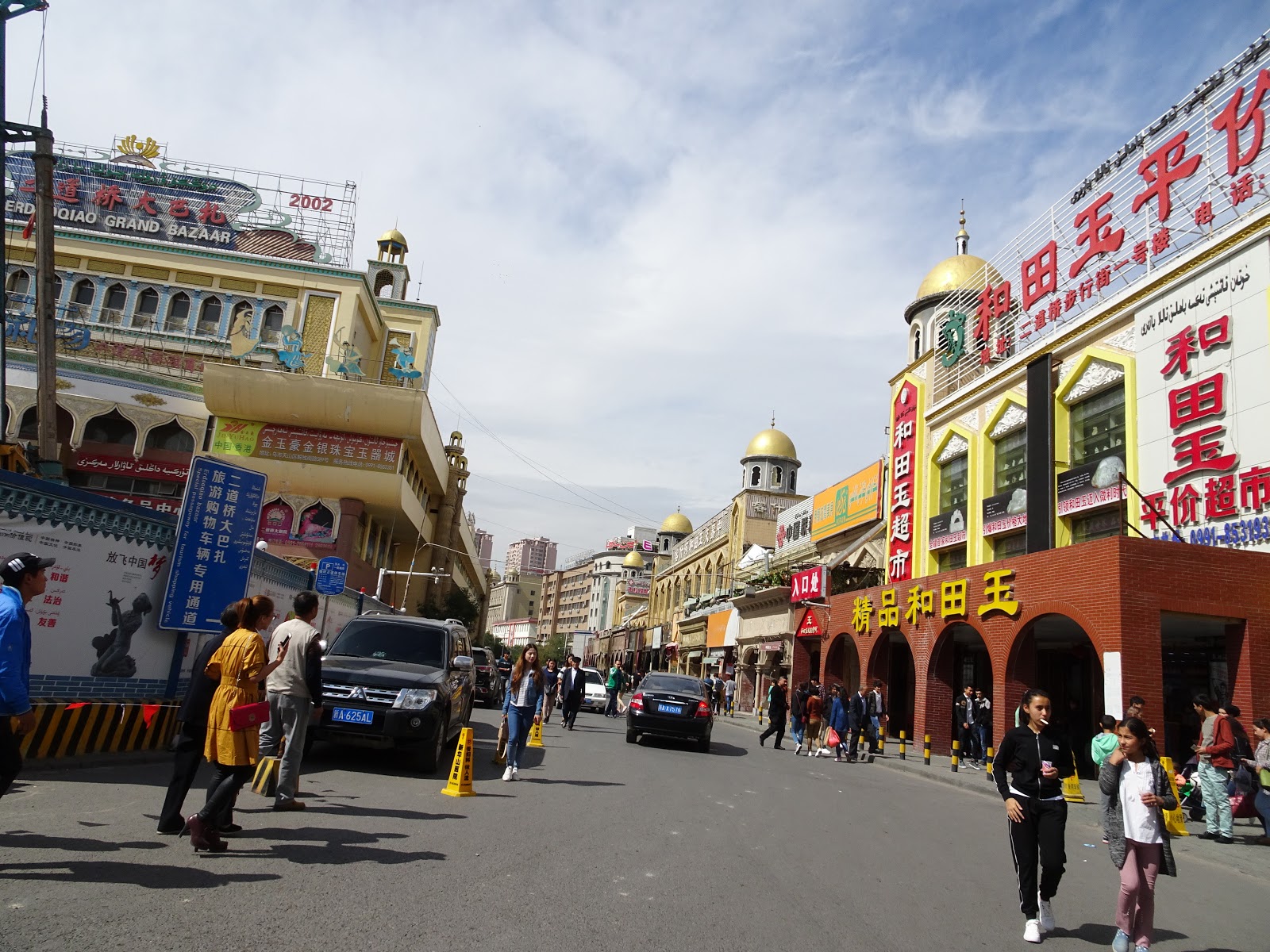
Near the end of the highspeed rail line on the westernmost side of Xinjiang, I found the last stop on my trip at the city of Urumqi, which China argues is the geographic center of all of Asia. Apon arrival I noticed that the tonal complexities of mandarin have eroded here, allowing me to relax my tongue while speaking with the locals. This is most likely due to the fact that this is a multi-language city, there is a 3.5 million population of Uyghur minorities here who speek the Turkic language of the same name.

On the Uyghur side of town

Turpan

The further west you go in China the more Muslim influence appears, in Turpan, you reach a tipping point where it starts to surround you. The city still appears to be structured in the same way that makes most Chinese cities similar, however, I would call this a "Muslim flavored" Chinese city. There are landmarks all around the city, including the flaming mountains and GaoCheng Ancient City, however for my stay, I decided to focus on what I was able to find in or near Turpan proper; Jiahe Ancient City(交河故城), The Karez Canal(米依木·阿吉坎儿井) and The Ermin Minaret(苏公塔).

My first half hour at Jiohe had me worried that I might have wasted my morning, the tourist entry gate, tram ride and museum gave me the impression that this attraction was a completely fake modern day representation of an ancient city. When we pulled up to the third tram stop I was relieved to find that there actually was a real ancient city here. It's not just a couple structures either, this is five square kilometer plateau filled with eroding ancient stone buildings and stone paths; walking the whole thing is a less mind-numbing then I worried it could be.

Jiayuguan

The main thing which interested me to visit Jiayuguan was an image I saw on google of an ancient guard tower on the edge of a fort surrounded by an arid, empty desert landscape, to even fly to this part of china was a spur of the moment decision and I didn't really know what I might find. The next morning after recovering from a flight and train ride I asked my hotel about visiting some of these ancient attractions and they were able to pair me with a driver for 180 rmb to take me to the three most popular ones on the west of town; The Overhanging Great Wall (Xuán Bì Cháng Xhéng), The Great Walls First Abutment(Cháng Chéng Dìyī Dūn), and The First Pass of the Great Wall (Jiāyù Guān).

After a car ride followed by a short golf cart ride, I was at the museum for the First Abutment. Inside there isn't too much to see except a couple old photos of the wall, and a group of belligerent tourists taking pictures of one another laying on the glass floor of a balcony looking over the Taolai River. This balcony would have a nice view, but with the commotion created by this glass floor, it is impossible to get a photo or even think for that matter; I did find an alternative viewing platform however inside the hallway leading to the mens bathroom. After I popped through the green plastic strips hanging from the door top, there was a wide and empty balcony from which the view was quite the same.

View from the bathroom

Donglianghua @ Dali

Half way between Dali and Weishan is a little 800 year old Muslim village called Donglianghua. On my way back from Weishan I decided to catch the small green bus and make a stop at there. I've been exploring dusty, crumbling places for the past week; so I was surprised to see that this place was clean as a whistle and in pristine shape in general.


Weishan @ Dali

Weishan is another ancient village about 50km south of Dali, however easier to get to than say Yunnanyi. You can take the bus directly there and walk from the bus station right into old town. This place has taken a hit from tourism, if Dadgendan Dai is a 1 and Lijiang is 10, then this is at about 4 on the scale of tourist-exploitation. It's an interesting fit because all the streets are pretty stacked with touristy stuff however marketed extremely toward locals, it doesn't have the influence of the lao wai so much yet.

Many of the buildings are marked as historical sites which are open for you to walk in and explore. I talked to some of the people in these and they said they didn't live there, I'm not sure if they actually knew why they were there at all. There is also a tram that goes around the town carrying tourists as far as you want for 1 rmb, I rode this for 15 minutes and did almost a full circle but was surprised that half of the circuit felt very much like new town.

All in all this place was neat but I think it's in an awkward stage of its commercialization, from where it stands now it's only a matter of time before it's more in the Lijiang - Heshan category.


Yunnanyi @ Dali

Yunnanyi is a two thousand year old Bai minority village south east of Dali which isn't lacking historical importance. The name of the entire province was derived from the the name of this town, which in older times was an integral stop between the south and northwest of Yunnan on the Tea and Horse Road.

I spotted this place on the blog Travel Cathay, a great blog documenting less popular attractions in south china. On the blog post were written detailed directions on how to get there from Dali including connections at 3 different bus stations and a ride in a rickshaw. Knowing that few foreigners are interested enough to go through the trouble made me more determined try.


Xizhou Village @ Dali

Xizhou Village is an old Minority Bai town about 20km north of Dali Old Town. Conveniently it's a straight shot on the highway north making it easy to find on your own. Since I had been on buses for the past 4 days, I decided to switch gears today and rent a bike for the journey. I realized after I had the bike in my hands that it may have been 10-12 years since the last time I rode one, the first 20 minutes were a little dangerous.

The highway north from Dali old town takes you through some beautiful farm land with a large mountain ridge always visible in the west. When I arrived I managed to miss the main entrance somehow and ended up first noticing the old architecture of the village when I reached the back side of it all, from here I decided to just lock my bike to a street light and started exploring.


Banqiao Old Town @ Baoshan

Yesterday I made a plan that I would take the bus from Baoshan to Dali, however before doing so I would make a visit to Banqiao Old Town. This is a small attraction just north of the city, and used to be a important hub for trading along the Old Tea and Horse Road.

This morning I made my way over to the bus station at noon and purchased my ticket for the bus leaving at 3:50pm. Afterward I walked up to the taxi stand and asked how much to Banqiao, the guy I was negotiating with told me he wouldn't use meter and wanted to charge 50 rmb there and back to the station. This price sounded ridiculous to me so I walked out onto the road determined to find my own way.

I talked to a couple taxis on the side of the road and here I was getting even worse answers then at the taxi stand, everyone said 50 rmb one way. Rather then negotiating, the next cab that pulled up, I just told them to turn the meter on, go straight and then turn right on the main road going north. This was working quite well until we got about half of the way there, at this point he asked for the location and I thought it would be safe to tell him now. I was wrong, we argued for a couple minutes and then I gave the 10 rmb that had accumulated on the meter and got out of the cab in a pretty desolate area near the north edge of town.

No taxis were even driving on this road so I began to wonder if I should have gone with the first driver's price after all, however nearby there was a bus stop so I decided to go check it out. After a couple minutes I was able to match the Chinese characters I'd photoed from google with one of the stop names on the bust stop chart. Eventually bus no 5 pulled up and I paid my 1 rmb and got in. The audio announcements weren't the least bit understandable so I was a bit worried I might miss the Banqiao stop, to prevent a miss I tapped the lady in front of me on the shoulder. She was very interested to know why I was on this bus, and after asking me a series of questions she agreed to help me find the right stop.

Five minutes later she gave the cue and I followed her off the bus, as we walked down the street she explained that since I was unfamiliar with the area that she would help me get to Qinglong street and also to the ancient temple just up the road. She guided me around for the next thirty minutes, even helping to suggest which things I might want to take a photo of and paying a small rickshaw fee for me.

Entrance to Qinglong Street
Qinglong Street

Baoshan

After arriving at Baoshan I made a visit to Taibao Park on the very west side of town, there is a trail you can walk along here which takes you from a lake at city level to the park at the top of the hill. This whole trip I've seen see that the people around me are surprised to see a foreigner and sometimes are shocked enough they even say 'lao wai' out loud and point at me. This has happened at least a couple times a day during this trip, but never have I experienced anything like the 45 minute walk to the top of this hill, I heard the word 'lao wai' literally about 100 times as one by one I passed by people who looked absolutely shocked at the sight of me. By the time I got to the top of the hill the word 'lao wai' was beginning to cause my body to twitch.


Blowing smoke rings

Heshun Village

Heshun Village is about 1 hour north of Lianghe right next to the town of Tengchong, it's surrounded by pine tree filled hills, farmland, and a beautiful lake at the edge of town. In the past the residents of this village were known for developing trade connections with surrounding countries, almost every family living here would have a member or relative who regularly traveled to neighboring countries for business or trade. This town has similar qualities to Lijiang, however it's much more embedded into nature and it hasn't been quite as terrifyingly commercialized yet. In Lijiang when you reach the edge of town, your surroundings immediately become urban, here you basically walk into a forest.


Ruili to Lianghe

In between Ruili and Yingjiang there's three long mountain ranges running north to south, these mountains aren't as sickening as the ride from Luang Prabang to Vang Vieng however they are about as beautiful, the whole thee hour bus ride I never got bored of staring out the window. As you come down the west side of the last mountain the Husa river runs along the side of the road, it drops in elevation much quicker than the road allowing you to get beautiful views looking down the canyon to the river as the elevation difference slowly equalizes. 

Ruili

Ruili is a small town in the far south of the Dehong prefecture of Yunnan, it lies smack dab on the border with Myanmar. The town is quite similar in appearance to Jinghong with lush surroundings and monsoon like rains, only it's scaled down to 1/10 the size and has most westernized things stripped out of it. If you're Chinese you can cross over the border to Myanmar for the day and visit the China-Myanmar friendship street, this connects Ruili to the town of Muse. Although I wasn't allowed, I could feel the Myanmar side bleeding over into China anyway.


Dadenghan Dai Village @ Ruili

Dadenghan Dai Village is a small village 20km south of Ruili which has been preserved as an ethnic minority village. From Ruili bus station there is a line which goes to the town of Nongdaozhen, however they will gladly stop at this village if you ask. When I got off and looked around I was sure there was some sort of mistake, from the road side it would be difficult to know that anything of this sort would be in the vicinity. Luckily after walking half a kilometer down the road I finally recognized a Buddhist temple from pictures I'd seen on the internet.


Humdinger Brew Pub & Uncle Johns The Brew Pub @ Kunming

After I sat down at Humdinger and browsed through the ipad menu, I quickly locked onto the sampler and ordered. Little did I know the sampler here is more like ordering a full glass of every beer. They all had a hefty hoppy taste kind of reminiscent of US craft beer, at least what it taste like 4 years ago when I was drinking it regularly; the Irish Stout was my favorite of the bunch. I had a chicken sandwich here which was pretty well prepared, fried and smothered with some spicy chipotle sauce, nothing mind blowing, but it was a welcome change after 4 days of Tibetan food and a cramped plane ride.

I have no complaints about this place, however the feeling here was much more the style of a large cooperate US brewery in every way, the HDTVs on  every wall, the brewing tanks behind glass, the incredibly large western food selection, the soft pop music selection, the overdone interior decorating and the carefully crafted lighting. After becoming familiar with some more rugged breweries in Beijing, this place kind of reminds me of what might happen if Disney created a brewery.

Cell phone for size reference

NapaHai Lake @ Shangri-La

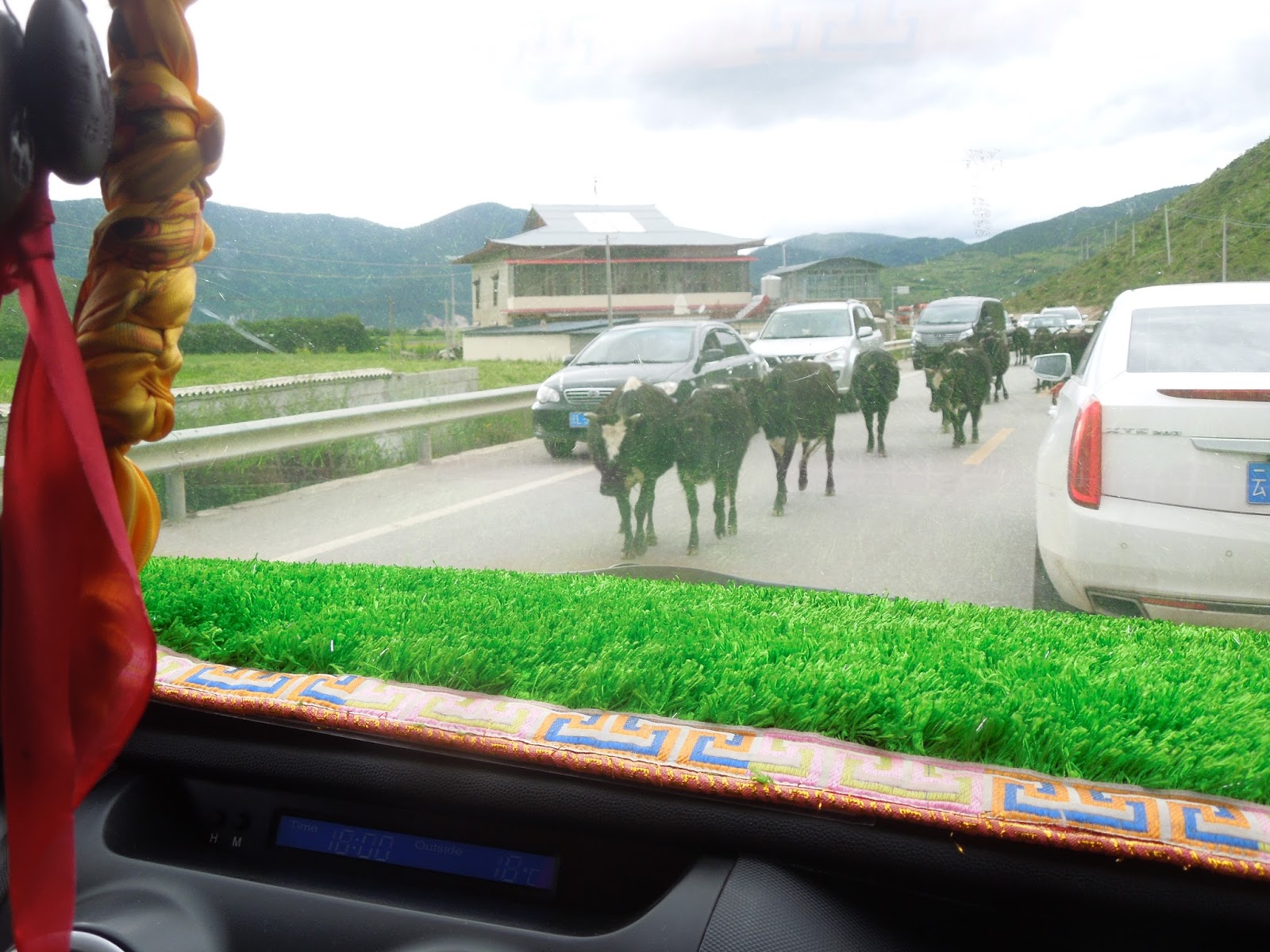
On the way over to NapaHai Lake we ran into a herd of cows, horses and sheep blocking traffic while an old lady tried to guide them back to safety by banging a stick on the ground, surprisingly this technique worked quite well.


Shika Snow Mountain @ Shangri-La

Shika Snow Mountain is a 5km high peak about 7 km west of Shangri-La. They sell appropriate cold weather clothing and oxygen tanks at the base, it's also equipped with a gondola, and wooden pathways all around the peak to make it an easy trip for any tourist.The gondola ride up consists of two parts and takes about 30 minutes total, giving you enough time to get to know the other tourists and take pictures of the terrain as you get closer too the top.

What was hard to tell from the bottom, is that today the top was inside of a cloud. The light faded around us as we neared the top, and when we finally were able to unload and look outside, all we could see is the silhouette of the rocky peak and Tibetan cloth decorations blowing violently in the wind around the shrines leading up to it.


Songzanlin Monastery @ Shangri-La

Nestled in the hills about 4km north of old town Shangr-la is the Songzanlin Monastery. In order to get here you can take bus 3, which takes off from moonlight square, or simply walk north for about an hour. The fee to get in is about 120 rmb, for which they drive you the final leg of the journey right up to the base of the monastery.

I started my exploration here with a walk around Lamuyangcuo Lake to take some snapshots. This takes a bit of time, however its well worth it to be able to capture the monastery's reflection in the water.